Ayce
Rank in 2025
#2,125
recorded as boys
Down 187 since 2024
—
recorded as girls
Babies in 2025
68
boys 68
Peak year
2021
102 babies recorded as boys
Popularity over time
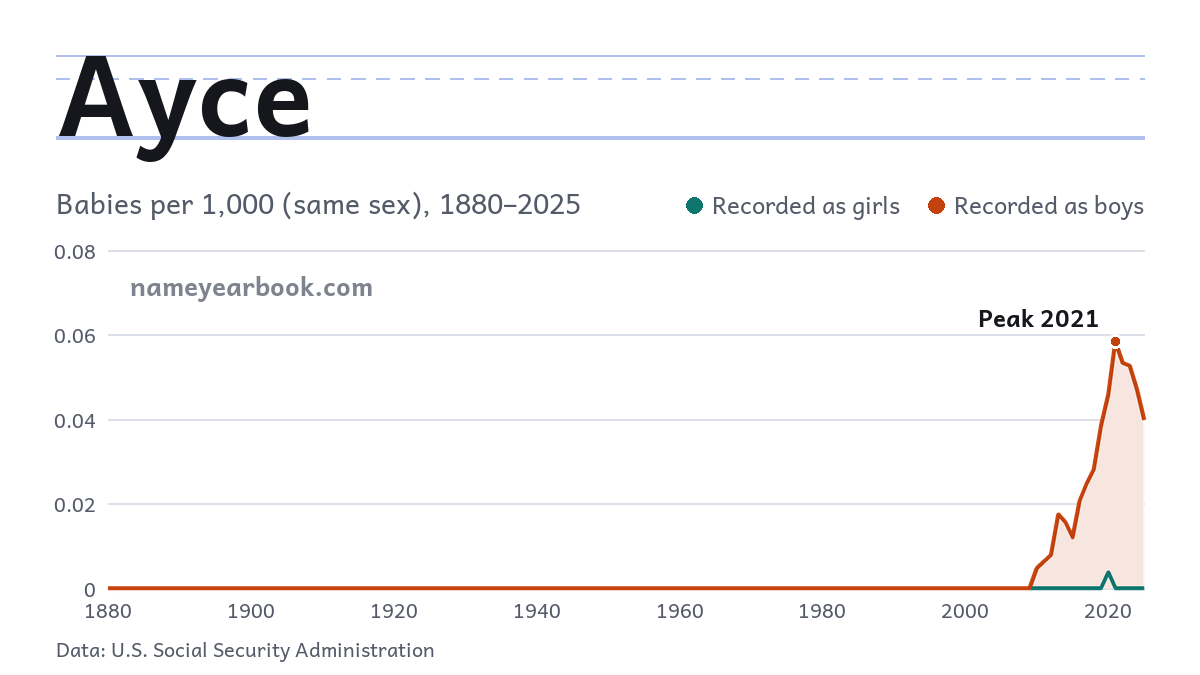
Babies given the name per 1,000 girls or boys recorded that year, 1880–2025.
Recorded as girls
Recorded as boys
Ayce was most popular in 2021, when 102 babies recorded as boys got the name (0.06 per 1,000). In 2025, 68 babies were named Ayce, ranking #2125 for babies recorded as boys. Its share of births in 2023–2025 was up 24% compared with 2018–2020.
Download or cite this chart
Show every year
| Year | Girls | Rank | Boys | Rank |
|---|---|---|---|---|
| 2025 | <5 | — | 68 | 2,125 |
| 2024 | <5 | — | 81 | 1,938 |
| 2023 | <5 | — | 90 | 1,787 |
| 2022 | <5 | — | 93 | 1,771 |
| 2021 | <5 | — | 102 | 1,635 |
| 2020 | 6 | 13,453 | 79 | 1,872 |
| 2019 | <5 | — | 69 | 2,081 |
| 2018 | <5 | — | 51 | 2,507 |
| 2017 | <5 | — | 46 | 2,672 |
| 2016 | <5 | — | 39 | 2,993 |
| 2015 | <5 | — | 23 | 4,295 |
| 2014 | <5 | — | 30 | 3,532 |
| 2013 | <5 | — | 33 | 3,265 |
| 2012 | <5 | — | 15 | 5,720 |
| 2011 | <5 | — | 12 | 6,578 |
| 2010 | <5 | — | 9 | 8,139 |
Compare Ayce with…
Born an Ayce? See how many share your birth year.
Any year from 1880 to 2025.
Free printables
Names with similar popularity trends
Their popularity rose and fell over the same years. They don't necessarily sound alike.
Where Ayce is most popular
Times more common than the national rate, 2016–2025.
Recorded as girls 1% · boys 99% across all years