Data story · US Social Security baby-name data, 1880–2025
The 14 names that came back from the brink
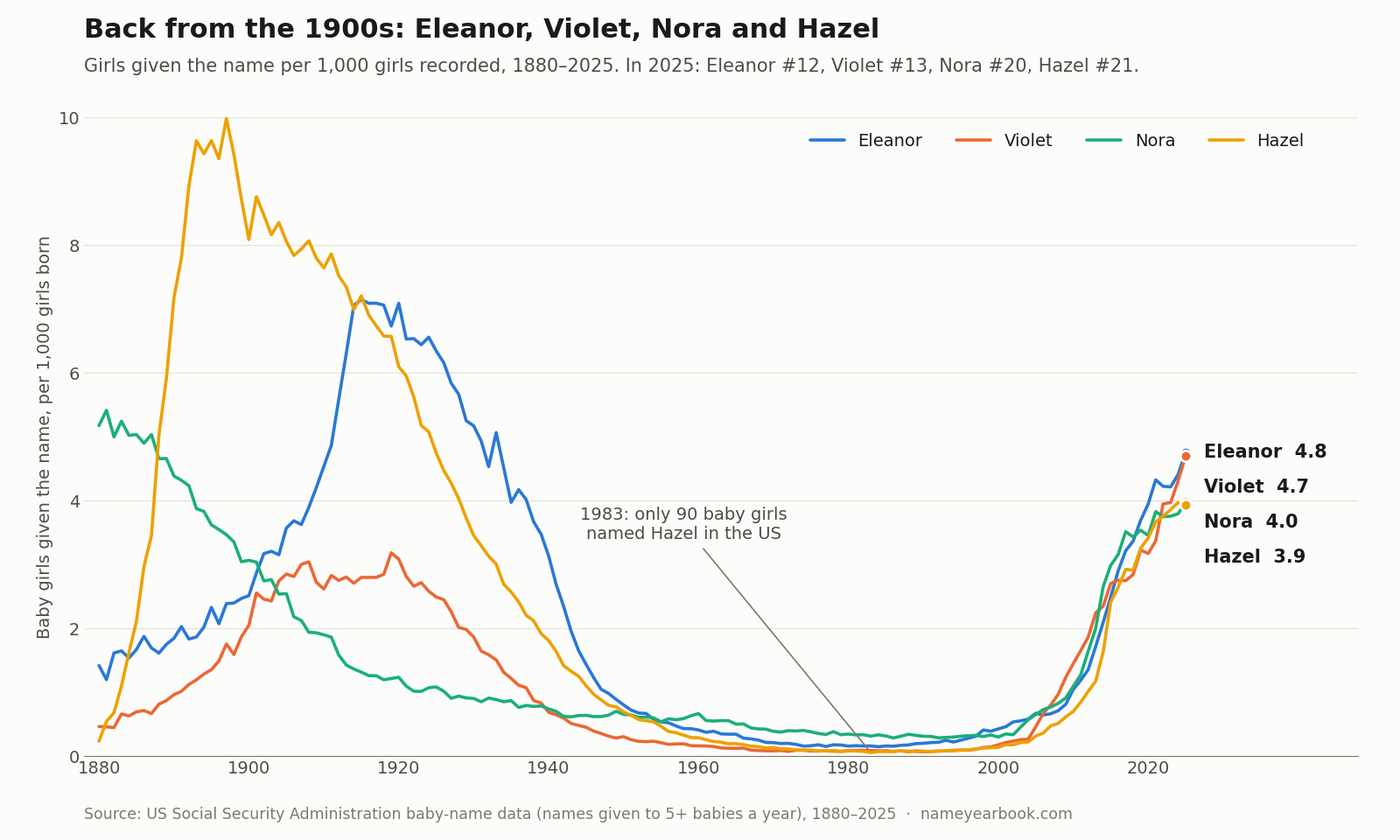
In 1983, only 90 baby girls in the US were named Hazel. In 2025, 6,318 were, enough to make it the 21st most popular girls' name in the country. Hazel isn't alone: we looked for names that were common in the early 1900s, nearly vanished in the second half of the century, and are common again today. Fourteen names pass all three tests.
What we found
- Fourteen names made the full round trip: each was given to at least 2 of every 1,000 babies of its sex at some point from 1900 to 1949, fell below 0.3 per 1,000 between 1950 and 2005, and is back above 2 per 1,000 in 2025.
- Twelve of the fourteen are recorded mostly as girls. Only Leo and Everett are recorded mostly as boys.
- Four are now more common than they ever were in the 1900s: Violet, Nora, Everett and Sophie are each given to a bigger share of babies in 2025 than at their early-1900s peak.
- The low point clusters in the 1980s, with a typical low year of 1984–85. Hazel bottomed out at 90 babies in 1983, Violet at 127 in 1990, Ella at 128 in 1987.
- Five are back in the top 20 in 2025: Emma #3, Eleanor #12, Violet #13, Leo #19 and Nora #20.
All 14 names
| Name | Lowest year (babies) | 2025 babies (rank) |
|---|---|---|
| Emma girls | 1976 (414) | 12,754 (#3) |
| Leo boys | 1990 (431) | 8,173 (#19) |
| Eleanor girls | 1984 (244) | 7,649 (#12) |
| Violet girls | 1990 (127) | 7,546 (#13) |
| Nora girls | 1986 (485) | 6,380 (#20) |
| Hazel girls | 1983 (90) | 6,318 (#21) |
| Lucy girls | 1978 (291) | 6,176 (#24) |
| Ella girls | 1987 (128) | 5,831 (#29) |
| Everett boys | 1995 (258) | 4,287 (#77) |
| Sadie girls | 1969 (80) | 4,168 (#50) |
| Stella girls | 1995 (125) | 4,136 (#52) |
| Josephine girls | 1985 (423) | 4,126 (#53) |
| Sophie girls | 1971 (66) | 3,984 (#55) |
| Clara girls | 1983 (310) | 3,601 (#63) |
How we measured it
Source: US Social Security Administration national baby-name files, 1880–2025. SSA only lists a name in a year when at least 5 babies of one sex got it, so a missing year counts as zero here: fewer than 5, not none.
Rate: babies of a sex given the name per 1,000 babies of that sex in the SSA files that year, for the sex each name is recorded as most often. Raw counts aren't compared across years, because far more births are recorded today.
Early peak: the highest rate from 1900 to 1949. We start at 1900 because SSA's records of people born in the 1880s and 1890s are thin; many never applied for a Social Security card.
Comeback test: an early peak of at least 2 per 1,000; a lowest rate from 1950 to 2005 of at most 0.3 per 1,000; and a 2025 rate of at least 2 per 1,000 and at least 10 times that low point. Only names given to 5,000 or more babies in all were checked.
Every rate was recomputed a second way from the stored per-year shares, and every 2025 count and rank matches the name pages. These numbers describe what parents chose; they don't explain why.
Please credit: Name Yearbook (nameyearbook.com), from US Social Security data.